
Where’s the swagger?
Anxiety stalks the government at a time when confidence is essential to see off the populists

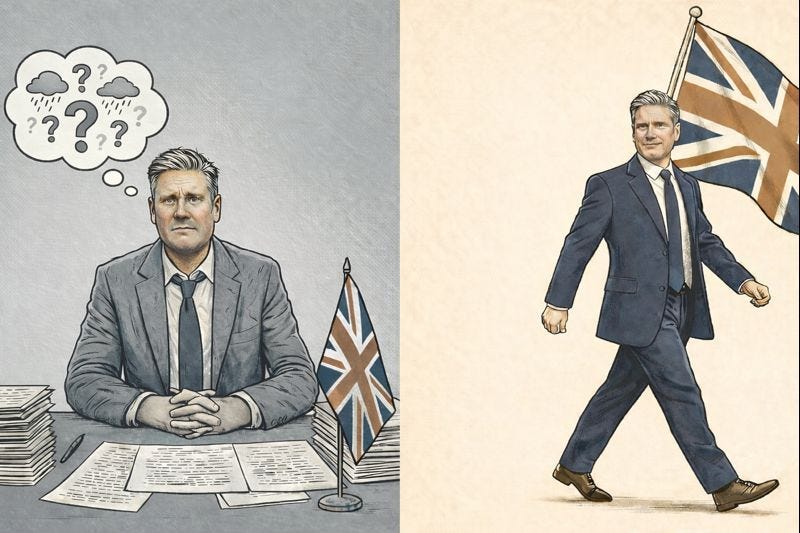
This was going to be a post about the 10 things Labour should do in 2026 to get back on the front foot. I’ve written about some of them in the last few months and it would look something like this:
Tell a compelling story about the future
Bring in talent who know how to deliver
Scrap the communications grid and start to win the big arguments
Take more risks
Win the battle of ideas
Grab attention - be more interesting and unscripted
Talk to real voters - all the time
Make a bigger argument about a growth plan and a new economy
Focus on aspiration, education and skills - stop treating people as victims
Open up - empower people to be part of a national project
But there’s one thing that transcends any of the items on this list. It’s a mindset. A stance. A way of approaching governing. It’s something that was put to me boldly in a recent conversation I had with a leadership expert.
“The one word I would use to describe ministers” she said, “is anxious.” “Anxiety defines this government.”
She’s right. The great governments have a swagger, bordering on arrogance. They have an inner confidence that they are winning not just elections but the big arguments. Trump has it in bucket loads. Why does the Labour government, with such a big majority, have so little of it?
Instead, as the leadership guru noted, there is widespread anxiety.
Anxiety about losing.
Anxiety about Reform.
Anxiety about the media.
Anxiety about not delivering.
Anxiety about being blown away by events.
Anxiety about blowing a huge majority.
Anxiety about the quality of thinking.
Anxiety about the state’s inability to get things done.
Anxious politicians are being aided by anxious civil servants.
Civil servants are still recovering from the battering they took from the last government. They have over the years created a vetocracy, multiple points of veto, all fuelled by anxiety.
Anxiety about not pleasing Ministers.
Anxiety about being hauled in front of select committees.
Anxiety about being blamed for mistakes.
Anxiety about judicial review.
Anxiety about being out of touch.
Anxiety about not knowing how to produce good policy.
Anxiety about being a generalist in an area needing specific expertise.
Anxiety about not being promoted.
In one corner, anxious Ministers and anxious civil servants. In the other, in-your-face social media, a hostile mainstream media and populist parties making solutions sound easy. It’s not a surprise who’s winning.
The doom loop of anxiety
Anxiety is contagious. If those at the top are anxious, it spreads to everyone else. And as any sportsperson will tell you, anxiety hampers performance. It leads to a crisis of confidence.
At the moment, anxiety reinforces anxiety in a doom loop. An ambiguous strategy, plus lack of a driving purpose, plus risk aversion, plus scarce resources, plus rapid change, plus overly-scripted messages, plus a bunker mentality, make it nearly impossible to engage the public in a national effort to turn around the country.
How can the cycle be broken? Not by the flick of a switch. You cannot mandate confidence. Just as the instruction to the timid to ‘grow a pair’, rarely, in my experience, results in a surge of courage.
These things need to be built. They are hard won. But there are steps that can be taken.
Negotiators and mediators often talk of ‘confidence building measures’, steps in the right direction - signs of the rebuilding of trust, connection and ultimately confidence.
Between now and May, this needs to happen. But it needs to start with a recognition that this matters.
To put it bluntly, there is a chance, some would say quite a big chance, that this is the last five months of Keir Starmer’s premiership. If that is the case, then the expression ‘shit or bust’ comes to mind. To use a sporting metaphor, he’s got to leave it all out on the pitch. No regrets. No what ifs. This is no time for caution. If it’s ‘steady as he goes’, he will be going. Instead, he’s got to be campaigning, arguing, making the case for the government, and breaking down all barriers to getting the job done. He needs to be out there ‘flooding the zone’ every day for the next five months. And that means a different energy and a bigger message than was on display in the BBC interview on Sunday morning.
Confidence comes from getting the foundations right. Thinking deeply so you’ve got your big arguments straight. Putting in place the architecture of delivery so you can get things done. Using the pulpit of government to explain and persuade.
In this context, the ditching of mission-driven government has been the biggest error of Labour’s first 18 months. Starmer’s five national missions were built over two years - and they were all about confidence. Starmer wasn’t into the ‘vision thing’, but missions gave him an ambitious set of goals and crucially a story to tell - a set of long term priorities to get Britain back on its feet. Missions provided a communications edifice: five pillars to base all messages around, as well as a delivery architecture. Mission government was a different way of running the state that would give it purpose and crucially a decisive sense of direction. It was a battering ram to break down Whitehall silos, to bring in outside expertise and to cut through the bureaucracy. Without the missions, too little of this is in place. Government is reduced to the short term and the transactional. The task now, and it needs to be done rapidly, is to turn some good policies - Digital ID, Pride in Place funding for communities, an expansion of apprenticeships, an AI strategy - into both a driving message about the future and a powerful forcing mechanism for a more responsive state.
Confidence building measures
To make this happen, there need to be concrete attempts to rebuild confidence between now and May.
First, ground the government in one big idea. Start by raising the country’s sights. Paint a picture of a Britain that people can believe in, invest in and raise their families in. Pick a big idea, stick to it, and drive it forward. There are plenty to choose from. Respect is the idea - and value - most associated with Starmer. So, show how the government’s policy programme all ladder up to the idea of respect. Again, in his 45 minute BBC interview, there was no sense of a big idea.
Second, pick two milestones that are important and can be met - and then meet them. That is the route to rebuilding confidence. The point is to choose those things that are symbolic of a government that can get things done. One of them should be asylum hotels. Closing all asylum hotels by May - which is doable - would show the government is listening, acting and making progress. The second one could be on new apprenticeships, school attendance or waiting lists. The key is to set a significant but achievable milestone and show tangible success. Success breeds confidence.
Third, change the way you do politics. I have written a lot about how communications needs to be overhauled. Another idea could be to introduce ‘radical transparency’. Make all the big decision-making processes public. Show clearly what the Prime Minister is working on each day. List the milestones, show the barriers, outline every action that is being taken. That level of openness would exude confidence and would focus attention on the substance of Labour’s plans.
The litmus test of a growing confidence
What should we look for in the coming months that will signal a growing confidence?
A starting point would be confidence in going out there and making and winning arguments on Labour’s terms. For more apprenticeships. For digital ID. For welfare reform. For tackling poverty. For growing the economy.
To take on opponents, to lead and shape the national conversation, to not follow the agenda of others.
Perhaps most of all, I suggest the litmus test is Labour’s attitude to Reform.
Do Labour politicians look at the Reform Party with fear, or do they see them for what they are, not just beatable - but flaky, shallow, chaotic, incompetent, unhinged and unfit to govern.
The big danger with all that is written about the rise of populism - and I have contributed to it - is that we start to believe that this is an unstoppable global phenomenon, a sign of the times, an inevitability. We start to see every half-arsed populist leader as the new Trump, and start to believe that mainstream politicians will be unceremoniously swept aside, that Farage’s moment has come and that Labour’s goose has well and truly been cooked.
But none of this is the case. None of this is inevitable. What’s keeping Reform chugging along and ahead in the polls, is not the brilliance of its thinking or the appeal of its policy programme, but the weakness of the mainstream parties - not least, Labour’s anxiety. If Labour and the Tories continue to flail, then people will vote for something more bracing and more robust. If Labour shows little fight, they will vote for the pugilist. If Labour bumbles and bobbles along, then voters will say “stuff the decaf, I’ve got a hangover, I want the extra-strong caffeine.”
The real enemy is not in the end Reform, but the anxiety holding Labour back.
Populists fill vacuums.
A confident government fighting for big ideas, making big changes, cutting through the bureaucracy, communicating every day with real voters in real places would wipe the floor with Reform - but time is running out.
You are right Peter. If this government fails, and that's what it's doing just now, for the reasons you set out, a great national tragedy awaits us. In my view, the PM is the key. He needs a much better team around him - people who themselves could almost be PM but who, recognising the national emergency, want Keir to succeed. The job of PM is, anyway, too big for one person these days - even without some of Keir Starmer's clear deficiencies.
Digital ID a good idea? No thanks. Blairite authoritarianism again. Anyway you can write what you like, Starmer hasn’t got it in him. He’s not a leader. You know what this post reeks of? Frustration and desperation.