

Anyone taking over an organisation needs to wrestle with a central challenge – how much continuity and how much change?
For Andy Burnham it’s tricky. He’s promised to stick to the 2024 Labour manifesto. He will inherit the same challenges. He has the same 403 MPs to choose his Ministers from. So on the surface there is unavoidable continuity. At the same he will want to show that he represents a big change - in priorities, in approach, in communications and hopefully over time, in popularity.
But how to do this?
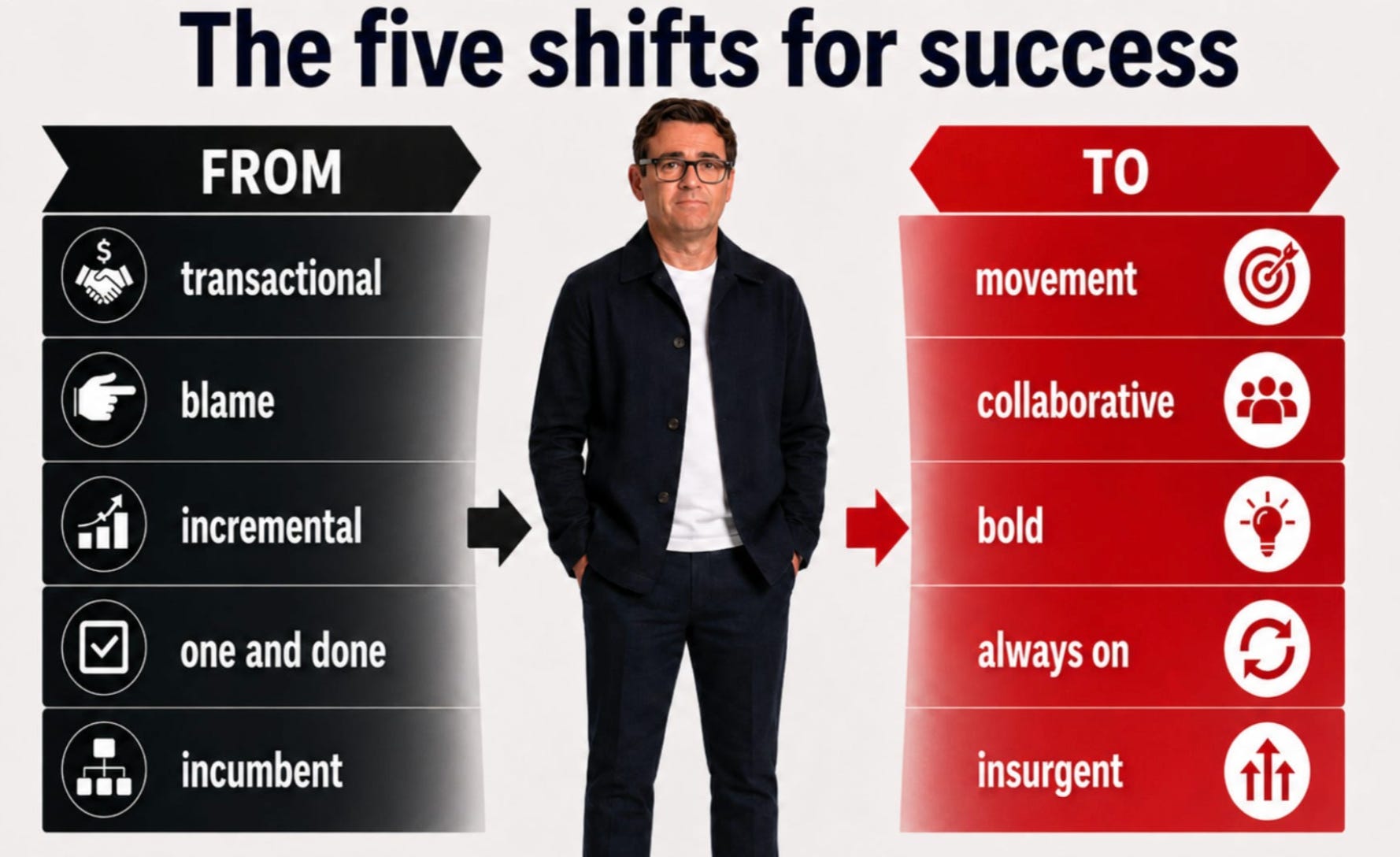
Here are five shifts in approach that over time could signal a different and more effective government. (More on A to B thinking can be found in one of my previous Substacks - here)
1. From transactional politics to movement building
Too much of politics has become transactional. The governing assumption of the last two years is that cutting waiting lists and helping out with the cost of living will produce a political dividend. But it hasn’t and it won’t. It’s not that these things shouldn’t be done. They are important. But they are not sufficient. Labour needs to start building a project. People want to be seen, to be heard, to be given hope, to be part of something bigger than themselves. None of the 4OO young Neets I spoke to across the country talked to me about their financial situation, despite all but a handful being skint. That’s because what mattered most was getting a job, having a purpose, feeling they were getting on in life. In other words they want politicians to promote opportunity not just security. They want wind in their sails. And so does the rest of the country.
Burnham needs to construct an ambitious long-term project for the country and the Labour Party. The difference between having a project and being a problem solver is the difference between being on the front foot with your own agenda and merely responding to events. We keep being told that Burnham has a big in-tray. He does. But he needs to create his own to-do list and not just have one thrust upon him. He has already articulated two causes that he could build into a powerful movement: putting power in the hands of people and places and giving young people their future back. Both are right for the country, right for the Labour Party and have emotional power behind them.
The mistake to avoid: believing that transactional policies will win back the public.
2. From a blame culture to a collaborative culture
Politics is inherently competitive and individualistic. Sharp elbows. Winner takes all. Departmental silos. Prime Ministerial patronage. All work against collaboration. All ultimately lead to a toxic culture: people briefing against each other to get ahead. Refusing to take responsibility. Blaming others when things go wrong. Using privileged information to flaunt their status with journalists.
There has been little pulling together in the last two years. The Number 10 culture, the cabinet culture, the Whitehall culture has too often dragged down effective government.
Creating a culture of collaboration, of purpose, of urgency, of innovation, is perhaps the most important role of the new prime minister. He needs to set a different tone. To be clear on the expectations; what is acceptable and what isn’t. Burnham needs to model it and act decisively when people defy it.
It starts by making the centre of government an enjoyable and purposeful place to work. This matters a) for the effectiveness of the government b) for attracting the best talent c) for riding waves of unpopularity or media onslaught.
The new cabinet needs to be built into a high functioning team. That requires time to work properly together. As a first step, they should all work in the same open-plan office over the summer planning the way forward, building trust, and collaborating across departments.
The mistake to avoid: believing the culture will take care of itself because Andy is a nice guy.
3. From incrementalism to bold reforms
One of the most powerful critiques of the last 2 years is that there have been good intentions and good policies, but there has not been enough welly behind them. There have been attempts to reform the planning system, yet too few homes have been built. There has been talk of closing asylum hotels but it’s painfully slow. There have been some measures to boost growth but they have been hampered by other policies that have stifled it. There has been a review of the curriculum and assessment but it was painfully timid, and failed to provide any way forward for our broken exam system.
If Burnham is to become the much-needed reformer of public services and the welfare state, then he will have to act quickly to put in place the architecture of real innovation and delivery.
In most cases, departments will not move fast enough nor have the infrastructure for delivery, so task forces or mission teams will need to be created: for tackling the Neet crisis, reforming schools, house building, parity of esteem between technical and academic education, closing asylum hotels, taking control of utilities, getting regional growth.
This requires a talent strategy to find the best leaders in the world for each of these areas. In each case, someone empowered to hire a multi-disciplinary team with the resources and the freedom to get the job done at pace. Think vaccine task force.
The mistake to avoid: believing that with a bit more oomph departments are equipped to deliver.
4. From ‘one and done’ communications to ‘always on’
The government needs to understand the full implications of new communications. This is not just about Andy Burnham being skilled on social media, though that is a start. It’s about totally ‘rewiring’ the way the government communicates.
This means moving from the government grid to a playbook method of communications. From a polished ‘event’ once a fortnight (one and done) to a continuous narration and explanation of the government’s intentions (always on).
By playbook I mean deciding on the campaigns and arguments that need winning and then going out and winning them every day. The current approach of only letting departments communicate when it’s their slot on the grid in three weeks’ time, means many arguments are lost before a Minister has started making the case for them.
I have argued for new roles at number 10 - the head of a content creation studio, (to produce video content) and the head of a story factory, (to generate compelling stories that provide real energy and debate in contrast to boring policy nuggets that go nowhere) which are essential if the government wants to seize the agenda and then keep it.
We need a prime minister who speaks fearlessly to voters every week – phone-ins, town hall meetings, serious engagement with opponents, including Reform voters.
The mistake to avoid: believing good social media is a substitute for a radical overhaul of communications.
5. From incumbent to insurgent
Burnham has rightly made much of his absence from Westminster over the last decade. In that time he has become a bottom-up politician, railing against the top-down injustices of an out of touch Westminster. So he has an argument and an enemy, great things for successful political narrative. He has the vibe of an insurgent but how can that be maintained once he is ensconced in Number 10? How does the ultimate insider, the person now presiding over Westminster and Whitehall channel that insurgent energy that is so desired by the electorate, particularly those frustrated by the timidity of mainstream parties? No10 North is part of the solution. So is the speed and radicalism of any devolution agenda and the rewiring of Whitehall. So is giving every region - including the North East, the South West, the Midlands, the South East - a pivotal role in key national projects of renewal.
The mistake to avoid: giving in to the pressure to shut up about Manchester!
There is one change that would affect everyone, support for bad parenting. A child learns its behaviour from its closest support group of parents, guardians and family. Everything else is peripheral. They say there's no such thing as a silver bullet but if this new system of Professional Parenting works, we just might have the answer to child abuse, anti-social behaviour and better and cheaper Social Welfare. . . . . and change the Security Council veto.
Agree with the shift to always on comms. This has to include summer and other periods when the govt goes MIA.