
Diamond Nine
Bringing a teaching technique into politics - with unpredictable results

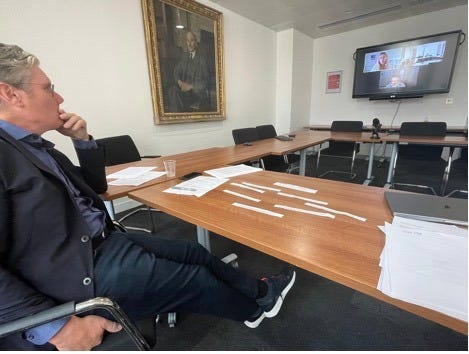
Let me start at the beginning…….
I was a new advisor to Keir Starmer in opposition. I had been out of politics for quite a while pursuing a career in teaching. Leaving politics behind after nine years working for Tony Blair, I became first a teaching assistant, then a history teacher and then a headteacher.
I thought how fortunate I was to be able to return to politics armed with fresh experience and a new toolkit that I hoped might be put to good use. Teaching children and developing staff had made me think deeply about the craft of running meetings, sharpening discussion, getting quickly to the heart of the matter. And I had another motive as well. There was always an imbalance between politics and the sectors it served - a superiority that comes from the politician having the power and money and the headteacher, hospital CEO or business leader having to show the required deference to get their fair share of it. What I felt was missing, was a recognition that the craft of politics could be enhanced by practices used in professions such as teaching.
I loved one technique above all others. It was my go-to activity for the classroom and sometimes for staff training. Because every time I used it, what ensued was something special – a discussion, a debate, a conversation – rich, deep, potent, like the finest Ethiopian coffee beans.
This technique had a name. Enigmatic. Beautiful. Twinkling with possibility. It was called Diamond Nine.
The idea was to have nine options or nine things or nine attributes or nine causes or nine hopes or nine possibilities - as you can see it didn’t matter what it was, but there needed to be nine of them. Not ten or eight. But nine. Each of the nine items was written on a separate piece of paper and placed in an envelope, ready for those taking part – pairs, small groups – to empty onto a table, ready to move them around as the debate began.
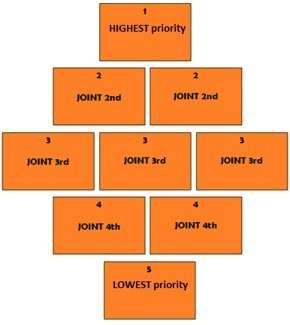
The task was to place those nine items into a diamond shape:
One at the top.
Two on the next row.
Then three.
Then two.
Then one.
The one at the top was your favourite, the best, the most important, the one that mattered most.
The one at the bottom was the least important, least favourite. The diagram shows you what it should look like.
The discussion was all about what should go where - and why. It forced the participants to justify their reasons, connect the different items and wrestle with trade-offs - deciding which of the nine were dependent on others and which you couldn’t do without. For example if you wrote out nine causes of the First World War and got students to do a Diamond Nine, they would have an in-depth discussion about short term, long term, and trigger causes and once done, each group could then move around the room analysing the thinking of other groups.
Similarly if you asked members of staff to have a similar discussion on the nine best ways to support children with special educational needs in the classroom, there would be a similarly insightful debate.
It works because the oracy combined with the manipulation of the pieces of paper, plus the formal structure of the diamond, creates a satisfying outcome.
So, just a few weeks into the job, and armed with an envelope, and nine cut-up sentences I was given an hour’s slot to work with Keir to get to the heart of what he believed. The feeling in the office was that there had been too much chopping and changing with themes and we needed to get to his strongest beliefs.
I was told repeatedly, he doesn’t like the word vision. He saw grand visions as too impractical, allowing people to dance around problems rather than solve them.
So on the nine pieces of paper, I wrote concrete objectives because I knew he wouldn’t want abstracts.
I cut them out, put them in an envelope and tried to reassure him that I had used this technique successfully on many occasions in education.
Keir humoured me. He opened the envelope gingerly and poured the nine bits of paper onto the wooden desk in the meeting room at party headquarters.
He read each of the pieces of paper in turn.
1. GROWTH ACROSS THE COUNTRY. Wages, productivity and business investment rise, and in every part of the country.
2. CLIMATE/ NET ZERO Britain is on track to become carbon neutral with zero-emission electricity by the end of our first term in government.
3. PUBLIC SERVICE REFORM Invest in and modernise public services in the community to prevent problems at source as our population ages.
4. EDUCATION AND SKILLS More young people leave school well-prepared for the future world of work and adults have the chance to improve their skills throughout their life.
5. MAKING WORK PAY More workers earn decent pay, progress, save and retire with dignity; and fewer people are trapped in poverty.
6. RESPECT AND NEW POLITICS More people feel pride and belonging in their country with decisions made closer to them, and more people trust government to create positive change.
7. INEQUALITY Tackle inequality and extend opportunity ensuring all parts of the UK are thriving, the gap between rich and poor is closed, that everyone is included in prosperity
8. HOME OWNERSHIP More people have the security of owning their own home and affordable home ownership is available to first-time buyers.
9. SAFE AT HOME AND ON THE STREET More people feel safe in their own home and on their street because crime is falling, convictions are rising, and law and order is restored.
I then took him through the exercise. The big question, I said, is: which of these is most important to have achieved after 5 or 10 years of a Labour government? Do any of the statements leap out at you? Which do you think are less important? Is there something you really care about that is not included?
It was striking that his first instinct, before a lot of discussion, was to put inequality first. “My aim is to look people in the eye in a place like Burnley and know that we have properly matched their ambition with the policies to help them thrive.”
This was the point in the hour when he was most passionate. He seemed to be a genuine ‘levelling up’ politician.
In the second row he put climate change and public service reform. Both, he believed, to be big, important causes.
As the diamond shape started to form, I tried to probe his thinking. How did he see the relationship between growth and tackling inequality? Should climate change be in the second row? Was the reason that public service reform was so high because it was a catch-all that allowed him to cover both health and crime?
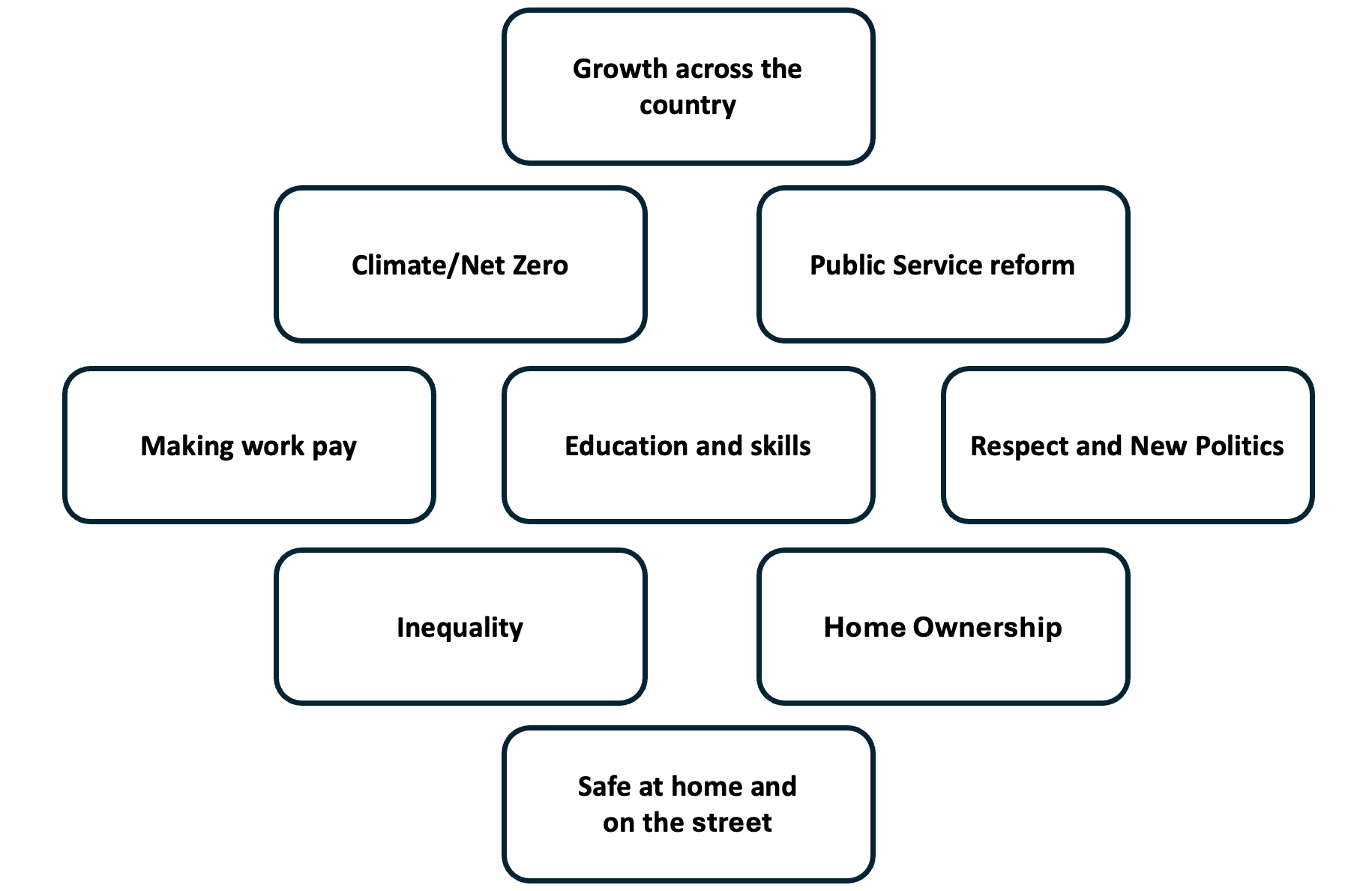
Others from the team joined on-line to discuss the outcome and bat around the different priorities. As the discussion developed, Keir became more convinced that everything flowed from growth. Without growth, there could be no equality and none of the other policies would be achieved. In the final formulation, tackling inequality came lower in the diamond.
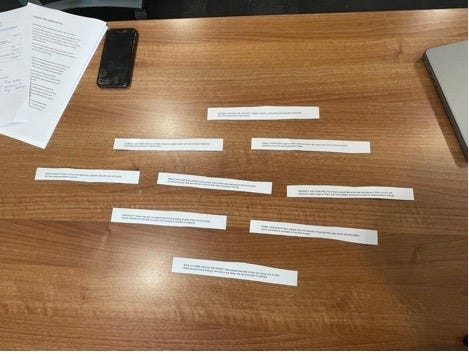
This was the final diamond from our session.
I’ve written it out more clearly here:
The meeting seemed to have gone well.
I was delighted that, as I had hoped, the process had focused debate and forced prioritisation.
A few months later, still slightly smug from the triumph of the first Diamond Nine exercise, and having used the same technique successfully on an election strategy planning away day, I attempted to use it again, but this time in an even more exacting environment: the main political strategy meeting.
In the room at the new Labour Headquarters was Rachel Reeves, Pat McFadden, Morgan McSweeney, Stuart Ingham, Deborah Mattinson, Katie Martin and Matthew Doyle.
Starmer has never liked political strategy meetings. He sees almost all of them as too circular, the iterative process mostly a waste of time.
Keir came in. I failed to read the room. He was not in a good mood. It later emerged that there had been a major malfunction with the autocue and precious speech prep time had been lost.
He looked at me holding my envelopes. I ploughed on. Keir seemed increasingly annoyed. I hadn’t seen him angry before. He appeared to be saying with his eyes: “Why has this idiot got his bloody games out again?”
I split the meeting into two groups with two sets of nine items. The purpose of this Diamond Nine, which was agreed before the meeting, was for us to get quickly to decide where we were vulnerable in the upcoming election and where we would be under most sustained attack. In short, we needed an answer to the vital question: If we were to lose the election, what would have happened? It was a way of getting ahead of the game and pre-empting attacks.
Again, there were nine options. It was mostly the usual charges against a Labour government. We would tax too much. We would be irresponsible on the economy. We would open the borders.
Both groups started debating. Keir was silent, fuming. He was not enjoying shuffling bits of paper around.
To be fair, the others including Rachel Reeves and Pat McFadden went along with the process.
In fifteen minutes there was consensus. In my experience this kind of agreement usually takes many, many hours of to and fro. The irony, lost on Keir at the time, was that one of the huge benefits of a Diamond Nine is that it forces a decision and curtails endless debate.
The issue that both groups put number one in their Diamond Nine was the commitment Labour had at the time to spend £28bn annually on the Green Prosperity Plan. The fear was that it would lead to a massive attack on Labour’s extra borrowing and at worst could lead to a Liz-Truss-style attack on Labour’s irresponsibility.
Again, the process had worked. But Keir was not happy.
The meeting quickly moved on to other business. There was not another strategy meeting for many weeks. I never dared use a Diamond Nine again.
Very illuminating Peter and love the method - may well try it out myself. Out of interest, if you had run this exercise for Blair when in no 10 how do you think he would have ranked the 9 do you think?
Can you imagine any serious leader being unable to decide on their priorities? Or being unable to understand the relationship between them and the requisite trade-offs? I guess it's useful to appreciate that climate change is high up the priority list but this article does confirm other recent pieces about KS (namely that he appears to believe that politics can be run on auto-pilot and that policy initiatives essentially announce themselves).