

Looking around Britain, the old settlement is crumbling. Institutions that have failed to modernise sufficiently are under siege and unable to respond swiftly to the needs of the public. The deep thinking necessary to move with the times has not been done. An abundance of examples exist: Whitehall, the NHS, the BBC, the Treasury, our school exam system - all operating by the old rules and old assumptions, unable to change the story.
The answer is A to B thinking.
A to B thinking has three components - each brimming with possibilities and pitfalls.
Define A - the current paradigm.
Paint a picture of B - the new paradigm.
Create the stepping stones that will get you from A to B.
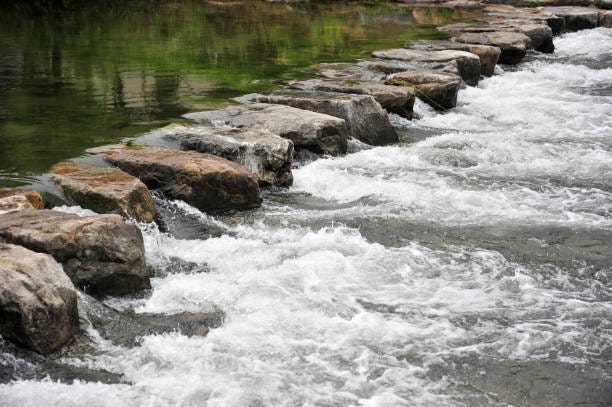
The metaphor I like to use is a fast-flowing river. You are on the bank of the river (A) and you are trying to get to the other side (B) across the treacherous waters.
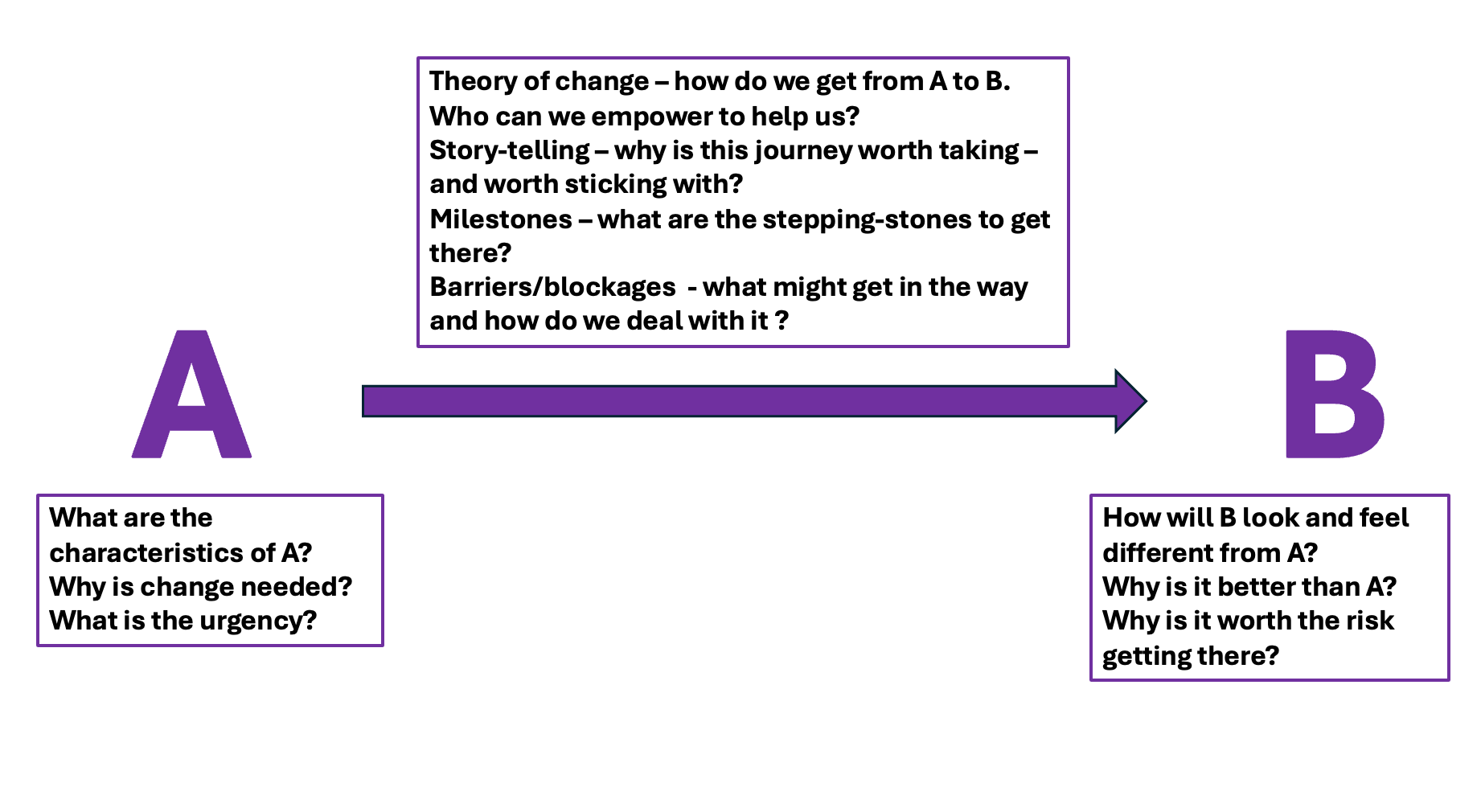
To do so, you need to ask - and answer - some important questions.
What is wrong with A? Why are you trying to get to the other side? Why is change needed? Why is the shore you are currently on so inadequate it is worth taking the risk to get to B?
What are the stepping stones to get you there? Why is it worth embarking on that journey? And what is so special about the other side of the river? In what ways is B going to look and feel different from A?
A to B thinking is how I have viewed much of my career - in politics, education, and strategic communications.
Old Labour to New Labour
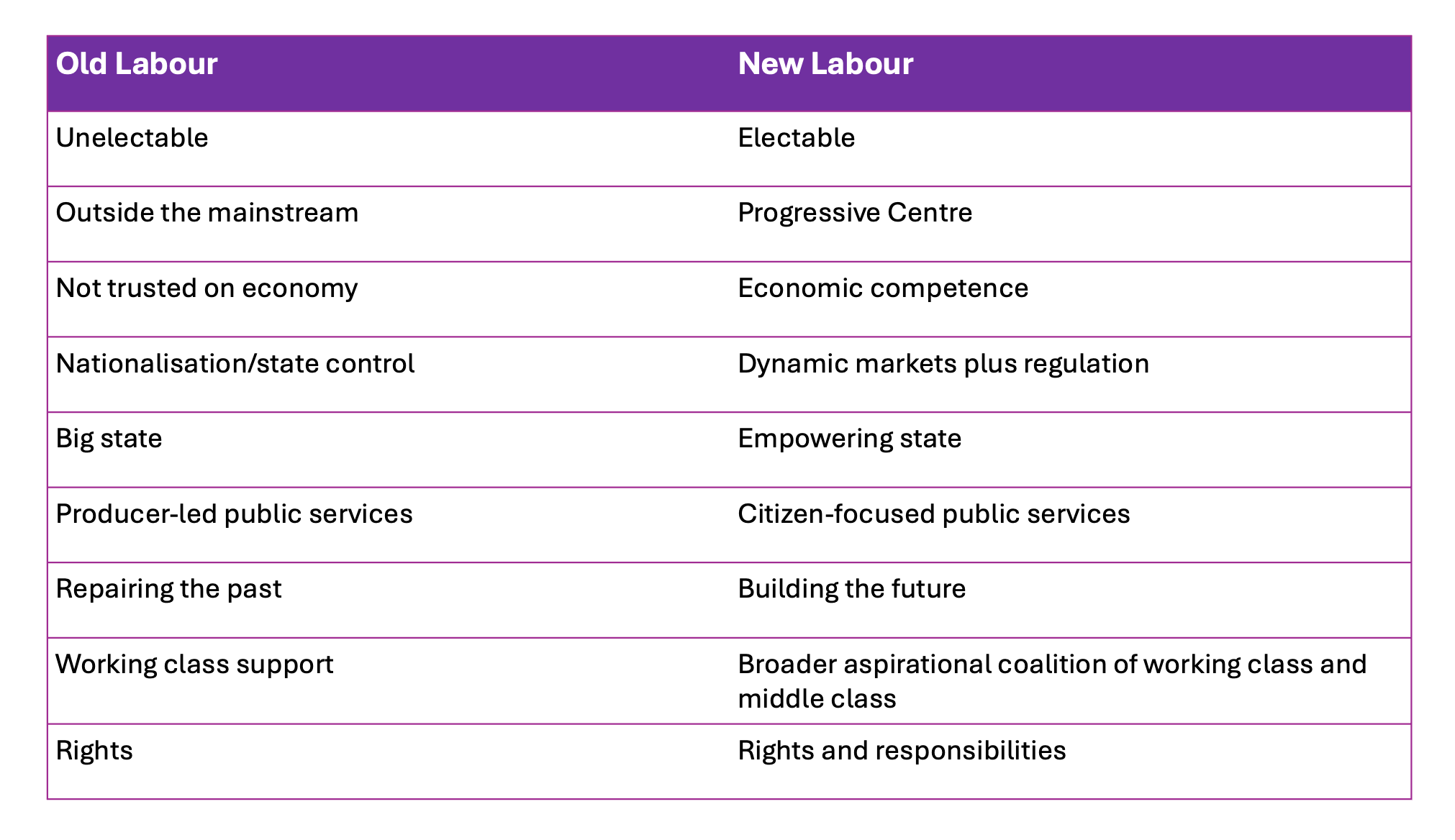
I was part of the team that helped move the Labour Party from Old Labour (A) to New Labour (B). From a party that was unelectable, not trusted on the economy, unable to tap into people’s aspirations, to one that built a broader coalition of working class and middle class support. A new party where education and aspiration gave people optimism that they could shape their own future. A party that didn’t make the electorate choose between social justice and economic competence.
There were many significant stepping stones to get from ‘A’ to ‘B’, including the rewriting of Clause 4 of Labour’s constitution, devolving power, making Britain a more tolerant outward facing country. It was all held together by an argument about modernisation and the need for both investment and reform.
Exam factory to Expansive education
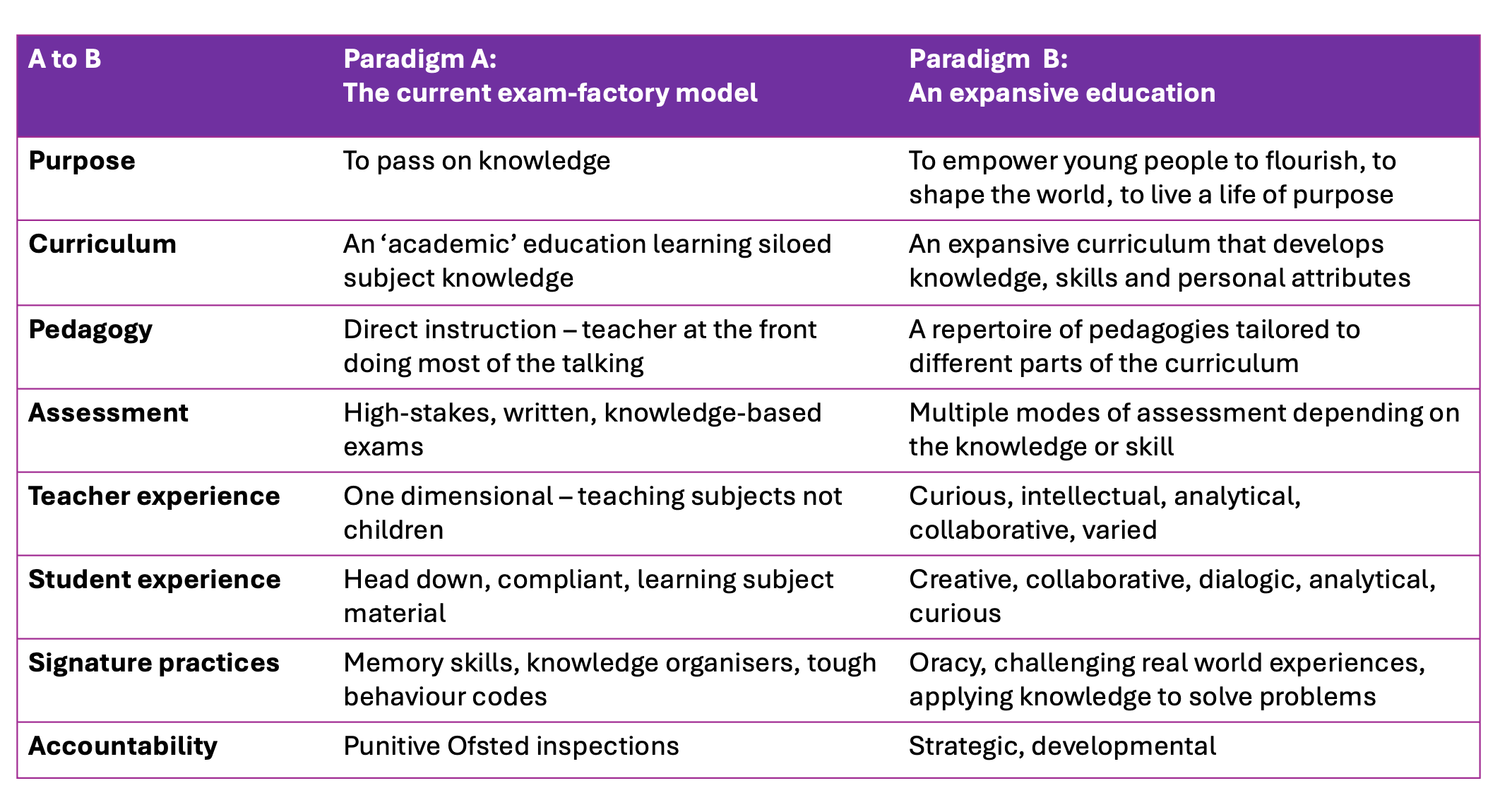
In education, the current paradigm serves a narrow purpose. To pass on knowledge and to do so by the teacher standing at the front and instructing young people who are usually lined up in rows. The job of the student is not to show curiosity or initiative but to keep their head down, comply with instructions and memorise material to be spat out in high stakes exams. Ofsted comes around, with its clunking fist, to put their stamp of approval (or not) on this process. The problem with ‘A’ is that while getting a good grounding in the basics and subject knowledge is a necessary foundation, this paradigm fails on two big things. First, it labels a third of young people as failures and turns many more off school altogether. Second, it fails to prepare young people with the full range of skills and attributes needed for a rapidly changing world.
That is why many countries - including the most high-performing - are looking at the needs of the modern world and changing how they do schooling. As a co-founder of new schools, I tried to move from Paradigm A to a Paradigm B (or as much as was possible given the straight-jacket of the current system).
Paradigm B is a more expansive education. The education of the whole child. It is about setting up every young person to flourish, to develop the full spectrum of human potential - yes, knowledge is important, but so are the skills and personal attributes that are vital in a world of change. With a broader curriculum, comes a broader range of pedagogies - making the teaching profession once more a joy to be part of, and lessons more engaging for students. In turn, assessment becomes more varied, both in what it assesses (knowledge, skills and attributes) and in how it assesses it (written, oral, project-based).
The stepping stones to get from ‘A’ to ‘B’ are constrained at every stage. Too many headteachers, teachers, parents have been locked into Paradigm A by the hold of league tables, Ofsted and exam results. They are led to believe that the exam factory is a fact of life. That it is too risky to make the curriculum richer and more expansive. As headteacher, I tried to do small but important things to broaden the education: each one a stepping stone from ‘A’ to ‘B’. Reinventing work experience so students from Year 10 did work placements every week for half a day - instead of an extra GCSE. No child taking more than 9 GCSEs. Tutor time, not a wasted 15 minutes, but 50 minutes three times a week to develop oracy skills, nurture well-being and wrestle with the moral dilemmas facing young people as they grow up. Challenging projects, in which subject knowledge can be combined - as it is in the real world - to solve problems.
Why A to B thinking is so much harder than it looks
One of the reasons that there is a constant critique of the government and of many of the floundering institutions of the state is that each of the processes of A to B thinking are weak.
Instead of describing ‘A’ calmly, rationally and fairly, ‘A’ is described by assertion. The Tories have wrecked the economy. The tax system is a mess. The boats are tearing the country apart. To be able to move from ‘A’ to ‘B’, there needs to be a well-thought through diagnosis of ‘A’.
Painting a picture of ‘B’ is often avoided, usually done badly, or done in a way that leaves many not wanting to cross the river to the other side but deciding instead to stick with what they know best. If change does not have a purpose and the promise of something better, why should anyone take the risk?
But the hardest part to get right is the route from ‘A’ to ‘B’. A fast-flowing river needs robust stepping stones. They need to be evenly spaced, able to bear weight and placed in the right sequence. Put another way, what is the theory of change?
There is an important message here for the policy wonk - to think not just about policy development, but process development.
So if ‘A’ is diagnosed badly, and ‘B’ is unattractive, or seems impossible, and if the boulders across the river are more like pebbles, then change pootles along - and you just get wet feet.
The vibe of B should be different from A
The biggest difference between ‘A’ and ‘B’ is often not an individual change, but something far deeper and more important: the culture, the vibe - the sense of hope, liberation even, that it engenders.
In 1997, at the fag-end of the Tories 18 years of rule, people could smell the decay, the fin-de-siecle feel, but what was hard to fully imagine, was the sense of release and optimism, that a new government would bring. What changed more than any policy was a sense of possibility. I still bump into people today - in fact some are Ministers - who remember that government as playing a vital role in their lives, tapping into their dreams and aspirations.
In schools, everyone knows the exam factory mentality has distorted what a good education is, has made childhood miserable for too many, and made teaching too formulaic. The vibe of school these days is less one of joy and more of the pressure to conform, to eke out results. What is hard to imagine, because too few are doing the imagining, is that with the right reforms, brilliant teachers could be given the freedom to develop the talents of young people to the full. That is why the lack of imagination, the failure to paint a picture of ‘B’, the doubling down on too much of ‘A’ has made the recent curriculum and assessment review so disappointing. And why it is encouraging that the Prime Minister has said he wants bigger reforms of the system.
In Britain today, the grind feels entrenched. Too many people feel stuck or going backwards. Decline is baked in and priced in. It is hard to imagine that it could be different.
We will never cross the river, we will never get to ‘B’, if politicians don’t start to imagine that better place and take bolder steps to get there. That requires bravery, not to throw pebbles in the river, but to place boulders in the water that are strong enough to resist the buffeting and weathering of the fast-running current.
People want to feel once more the optimism that comes from a sense of possibility. Ultimately the aim, surely, is for people to move from an ‘A’ of surviving to a ‘B’ of thriving.
I can’t tell you how much I agree with this. The feeling of hope those first steps out onto the waters brings, and the hopeful flags fluttering on the other side, still make me excited about the future. In describing ‘A’ we need humility to be honest, and in defining ‘B’ to allow uncertainty without losing definition and drive.
"In 1997, at the fag-end of the Tories 18 years of rule, people could smell the decay, the fin-de-siecle feel, but what was hard to fully imagine, was the sense of release and optimism, that a new government would bring. What changed more than any policy was a sense of possibility."
Think this captures why the current government is so unpopular - many people had great hopes, and feel let down by the lack of progress, lack of optimism and general poor performance.