
A Missions Mindset
The inside story of how mission-driven government came about and why it's now the key to turning around the government's fortunes.

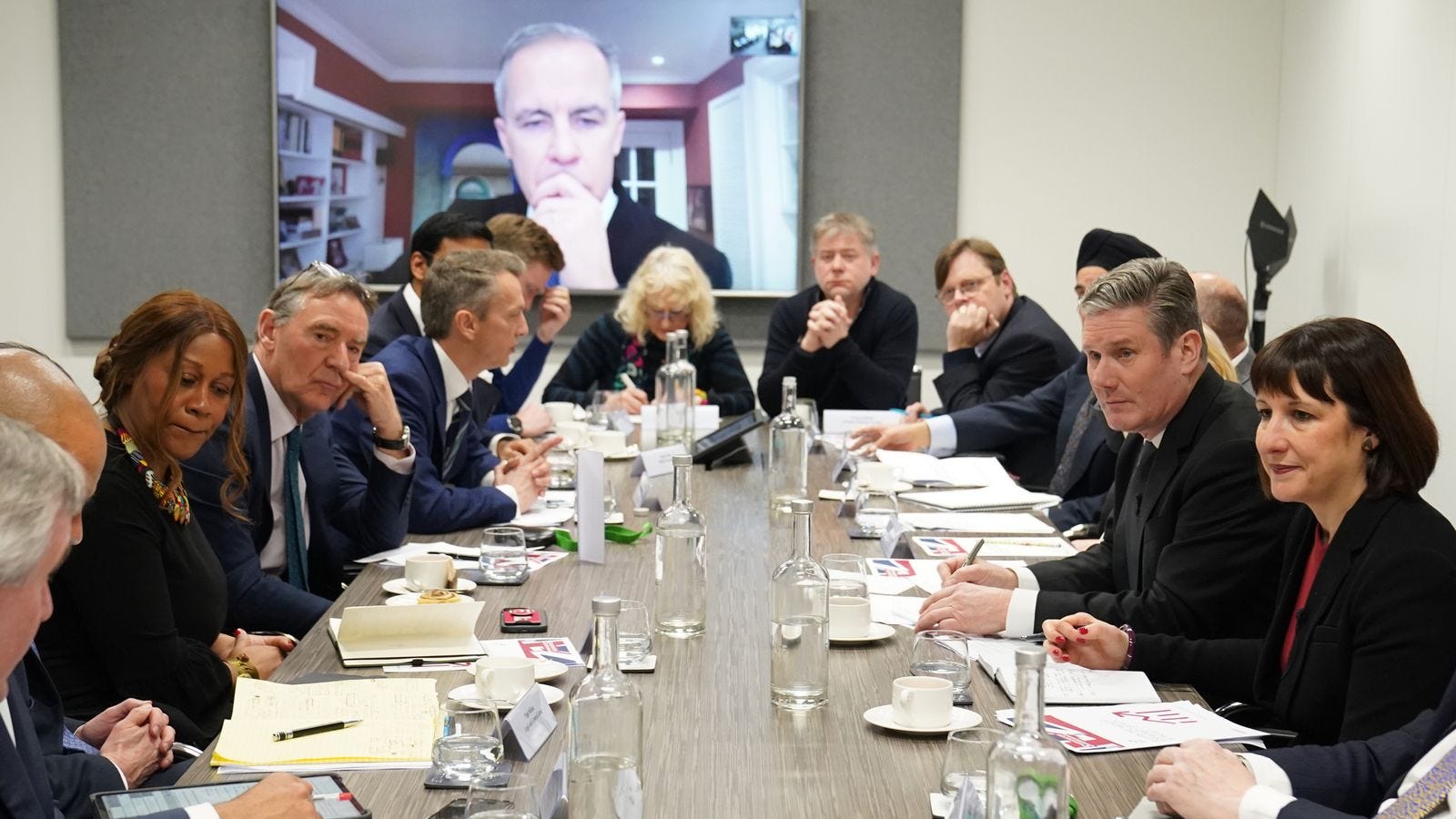
Most of us have been on work awaydays. Those slightly cringy events where you are never quite sure whether to dress up or dress down. And you don’t know if you should be in ‘bonding and banter’ mode, or ‘suck up to the boss so he knows how good I am’ mode.
The shadow cabinet awayday in February 2023 was no different. Held on the 22nd floor of a Canary Wharf tower block (it’s always exciting to be out of your usual workplace!) there were views to die for and snacks to fight over.
I was there with LOTO (Leader of the Opposition) colleagues to sell the missions. Or at least explain them.
Three years into Starmer’s leadership of the Labour Party, brilliant work had been done moving on from the Corbyn period, and opposing a dysfunctional Tory party. But what was absent was a way of describing Labour’s programme for government; of harnessing the disparate bits of policy-making into a coherent project.
Mission-driven government was not just an approach championed by economist Mariana Mazzucato, but was being used in countries across the world and by certain English councils to galvanise local change. The last Labour government’s promise to end child poverty in 20 years - an ambitious cross-cutting goal - was definitely a mission, though we didn’t call it that at the time.
Starmer wasn’t comfortable with a grand vision, but missions were the next best thing, providing ambition once more for the country, but of a very tangible and practical kind.
For Starmer the mission thing is the vision thing.
Like most awayday audiences, the shadow cabinet could be divided into three. The ultra-loyalists, ‘this is probably a good idea, I’ll give them the benefit of the doubt’. A middle third with the attitude: ‘this is almost certainly a bit stupid, but it’s in my interests to go along with it” and, the sceptics. “Can’t you just give us a pledge card and we can get on with it.”
The following are some of the slides presented to the shadow cabinet at the awayday. They remain useful for explaining the rationale behind missions and why today they are more important than ever if the Prime Minister is to make good on his new mantra of ‘delivery, delivery, delivery.’
I started by defining missions. Key to this was the idea that this was not just another word for pledge or promise but signified a different approach altogether. To be honest, we never fully succeeded in conveying this message.
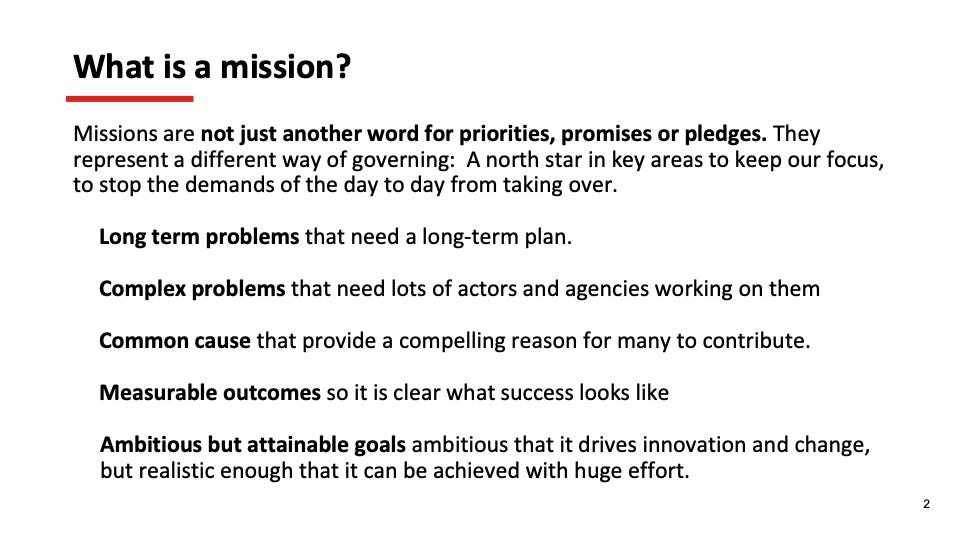
The biggest criticism of Labour in its first year in office is the lack of strategic direction. Yet, it has in its locker this approach to governing that provides that driving sense of purpose. Missions are a way of thinking long term, upping the sense of ambition and providing policy and communication anchors to give shape and structure to the government.
We wanted the missions to chime in with key priorities of the public and at the same time genuinely tackle the thorniest cross-cutting issues. So we spent months working on what the missions should be - what would be included and what wouldn't.
Should housing get its own separate mission or should it come under growth? It ended up under growth. Should rail nationalisation, which was very popular, have its own mission? Again we thought, it didn’t meet the criteria of a big cross-cutting goal. Where would we include boats, which was important, but again didn’t fit the 10 year horizon in the same way? The answer was to include it in one of the three foundations alongside national security and economic stability.
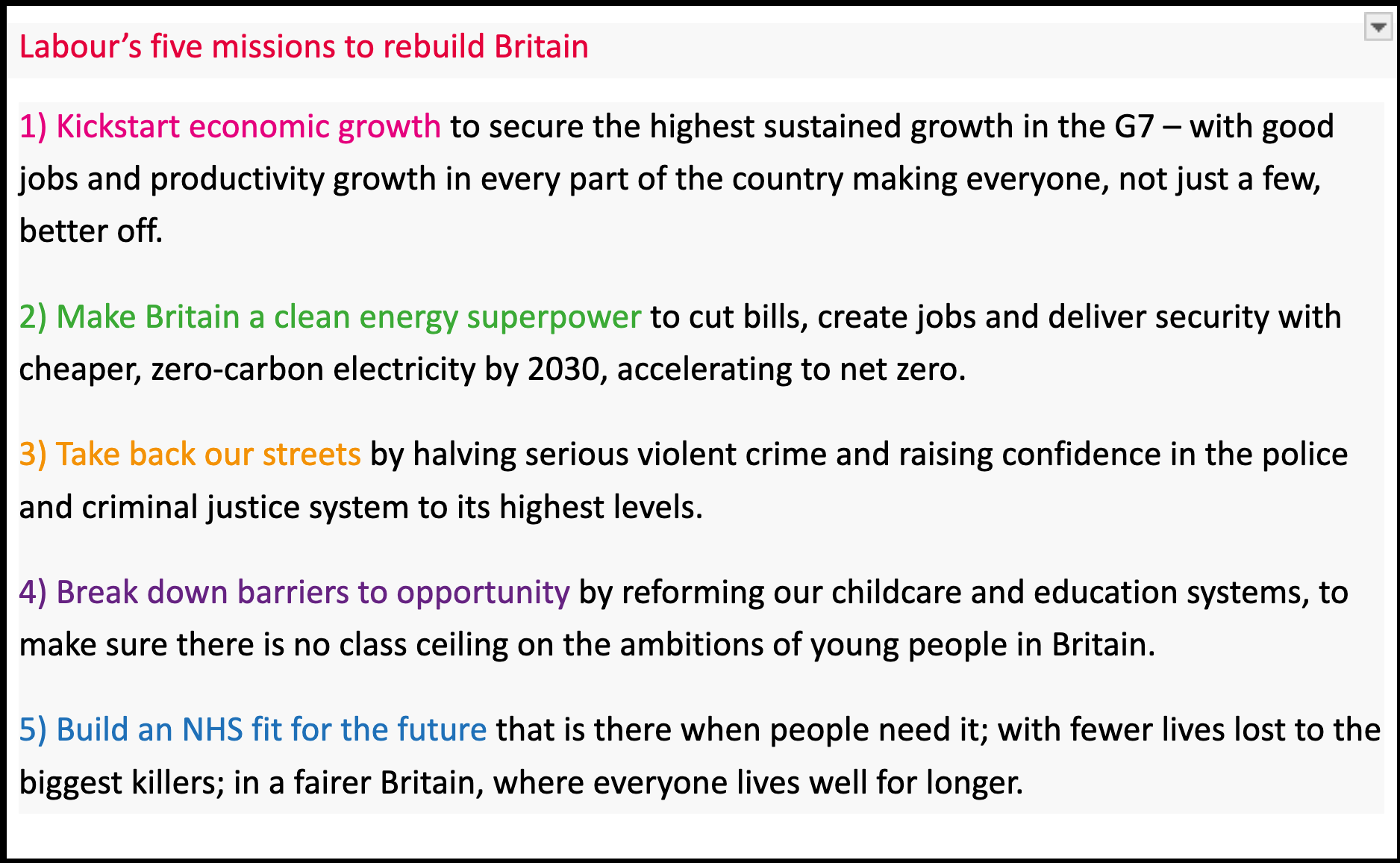
We had several iterations of the wording of the missions and ended up with these in the manifesto.
Taken together, we explained that the five national missions added up to a project to rebalance the country in favour of working people - something worth fighting for.
Getting the right balance between trying to inspire and reassure was central to our strategic discussions in the run up to the election. I always wanted us to provide more inspiration, reasons to vote Labour. Others believed that we should focus on reassurance to maximise the anti-Tory vote.
In government, missions are now strategically important in a new way. They can help Labour get the better of Reform. While Labour of course needs to neutralise boats and hotels, missions show that the government is thinking about the future and has something bigger and better to offer, while Reform are playing off the grievances of the present.
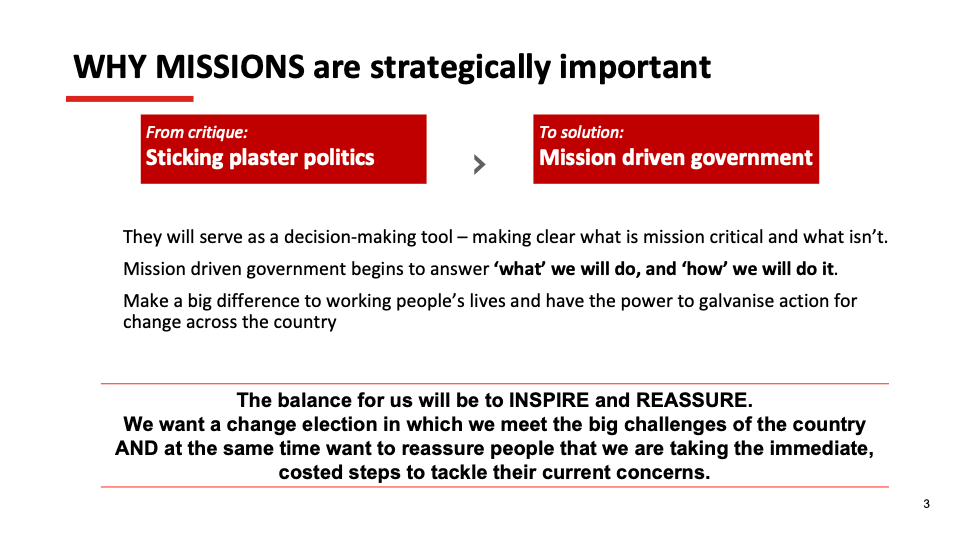
It was crucial to show the shadow cabinet how missions fitted into the strategy. I wanted to explain to those who were itching to roll out the doorstep retail offer, that it made no sense to start with the pledges. Pledges are the tip of the sword but you need the rest of the sword. For example, Blair’s pledge of cutting class sizes to under 30 for 5,6,7, year olds before 1997 would have been of no real value, unless he had already made the case, over many months, for ‘education, education, education’ and had delivered speeches explaining why a knowledge economy was key to the country’s future.
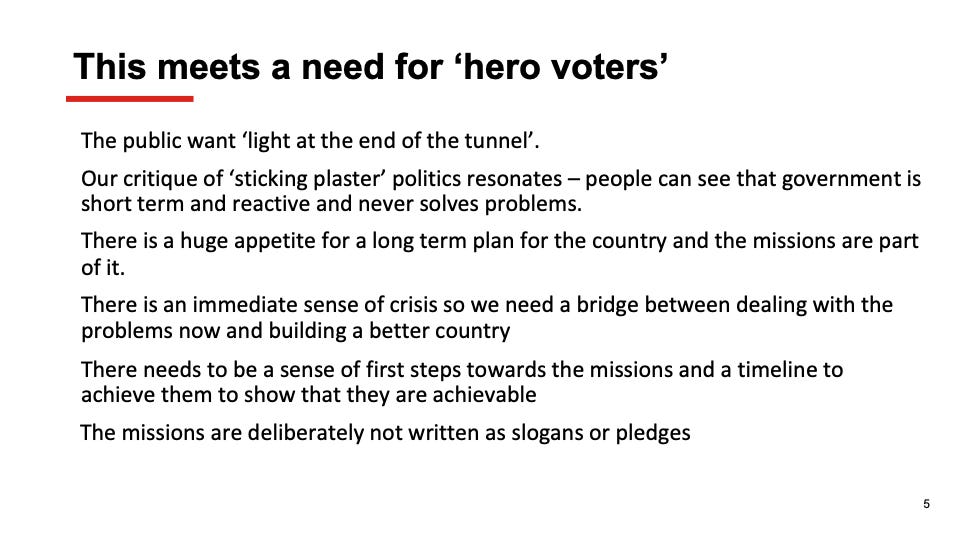
What I found particularly interesting when we tested the missions with the public was the appetite for long-term plans. The received wisdom was that the current cost of living crisis was so dominant that voters wouldn’t have an appetite for anything other than immediate change. This wasn’t the case. People understood Britain was in a mess, and were realistic that it would take time to turn it around. What they did want was tangible first steps towards the long term goals.
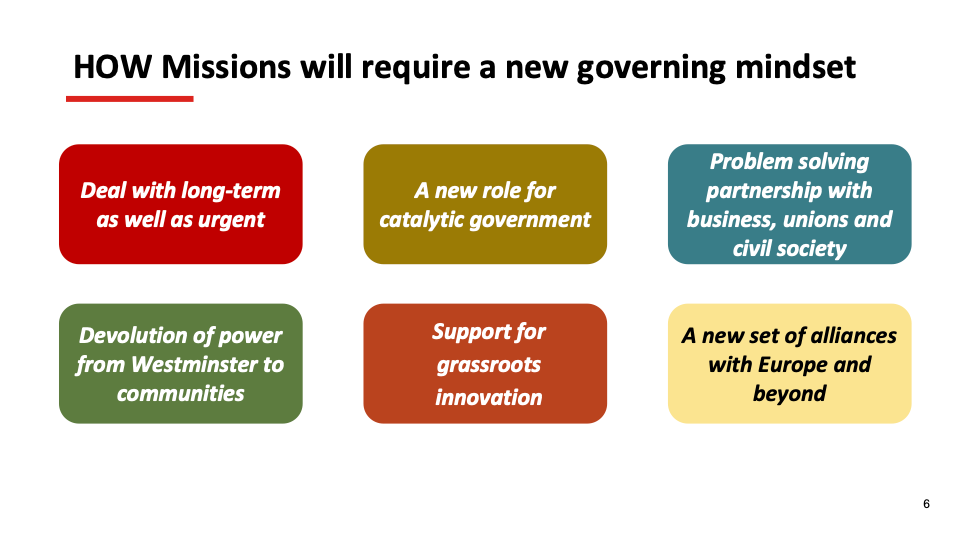
Missions required a new mindset: urgency, innovation, disruption. Unlike almost everything else in Whitehall, missions are based around achieving a specific outcome for working families, through assembling a crack multi-disciplinary team to innovate, empower communities and ultimately to get the job done. It requires a new partnership between government and the private sector and civil society, devolution of power, and a new culture of innovation.
In short, mission-driven government is a battering ram to reform the state. It meets the public’s desire to shake things up.
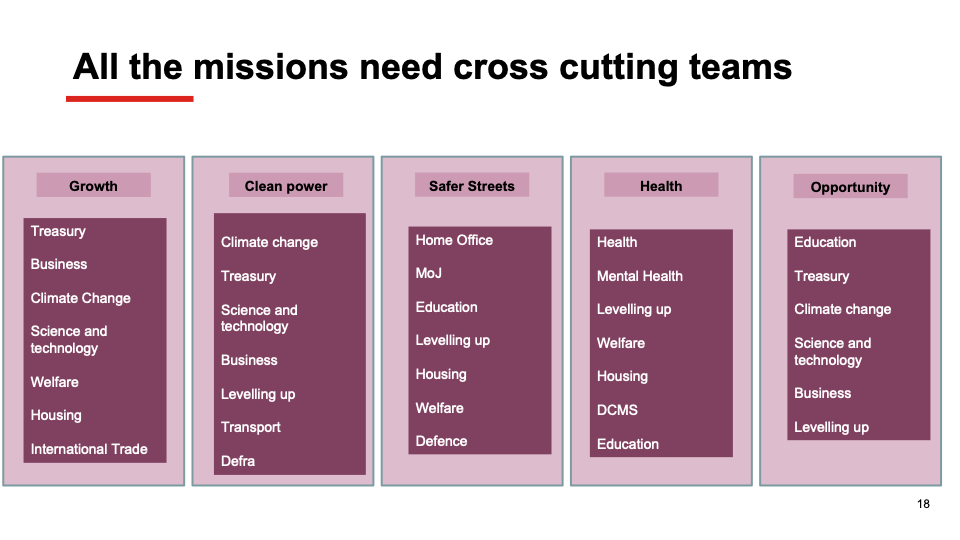
The slide below was a way of indicating the cross-cutting nature of all the missions. Every single shadow cabinet member would have an important part to play.
It was also a way of grouping shadow ministers for the inevitable break-out session at the awayday - which I was told in advance that most of them loathed. I wasn’t quite sure why, but it seemed to be a) because they want the leader to see their brilliant contributions in front of the whole group and b) because they have no faith that the leaders’ staff care what they say in these smaller groups.
Launching the missions
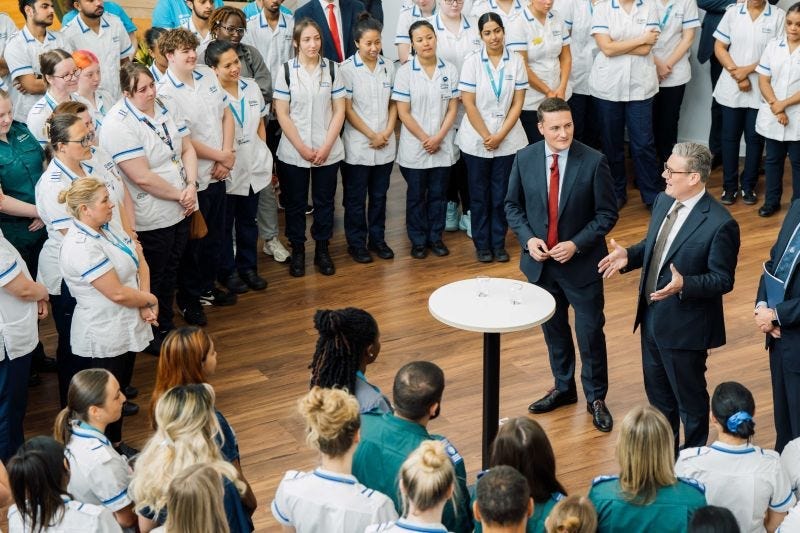
Starmer’s launch of Labour’s 5 national missions was filled with optimism. A patriotic message about getting Britain back on its feet:
“Ambitions that won’t be overtaken by the future. That raise our sights and, at first glance, seem too bold, invite a sharp intake of breath, a question – can this really be done? And then, when the doubts begin to subside, a new emotion and a new determination. Why not Britain?”
They were not Starmer’s missions, rather they were national missions, designed to empower people and organisations in every community - to play their part in ‘a decade of national renewal’.
Again, in Opposition, Starmer put this well:
“Mission-driven government. In some ways, it’s a simple idea. Every business around the world – every organisation – has a strategy. A nation needs one too. A plan, a framework, a compass – that acts as a guide for everything we do. Making clear what is mission-critical for my government. And what isn’t. A clarity that will ruffle feathers across Whitehall and beyond. But one that is necessary. Necessary to build Britain’s long-term strength. Necessary to galvanise action for change across the country.
To kick it off we launched a short mission-driven government document outlining the new approach.
We built a coalition of practitioners and experts around each mission and Starmer met many of them at roundtables. The boldness of the goal - for example, halving violent crime - immediately lifted these conversations to a new place, where the stock answers would no longer do.
Policy documents were published alongside each Prime Ministerial mission speech. (economy, crime, clean power, health, opportunity). And Starmer went across the country bringing the missions alive for each community.
Why missions have been downplayed
But, in government it’s been a bumpy ride for missions. There have been pockets of activity (which I will go into in the next post) and some key departments have introduced elements of the approach, but the architecture of missions has not yet been put in place properly across Whitehall - the cross-cutting project teams, the spirit of innovation, the long term plans. There’s been talk in the last week of missions being watered down at the centre.
What has happened? The Plan for Change document has focused on a small number of delivery imperatives that will help Labour get re-elected, in particular boats, cost of living and cutting NHS waiting lists. That prioritisation is, of course, important. But it seems to have come at the expense of an ambitious, long-term agenda that missions represent.
Mission-driven government is a threat to the old ways of working in Whitehall and so has to be driven hard if it is to happen.
Labour promised a decade of national renewal and that requires a national effort to turn around the country, something beyond a few transactional wins, however important they may be.
A missions mindset is the way to accelerate delivery and at the same time build a more compelling narrative. Both will be crucial in Labour’s second year.
This is the first of two posts that makes the case for a ‘missions mindset’. This piece has focused on why the missions. The second piece will lay out how to put missions into practice.
I fully support the approach and the mindset, but not the expression. These missions are so dull. They're not what you want for the 'tip of the sword'. Nobody's going to die on any of these swords. Ask yourself: are these missions burned in to anyone's hearts or minds? Are they capable of changing how people feel, think and act? Are they inspiring co-ordination? Can we SEE progress and FEEL success - or are we reduced to debating the reports of the Office for National Statistics? (For example, the ONS says that "there is no single measure of violent crime" - so we can squabble about mission 3 forever). These rockets are likely to fail, not because they're pointing in the wrong direction, but because the fuses are too damp.
Ive just been on a heritage day walk around historic Sheffield. The cutlers had two missions: quality and integrity.
I’m afraid the Labour Party have gone down the route of corruption and wishful thinking.
Corporatism and spin in otherwords.